

#10 Awareness Is Not the Work
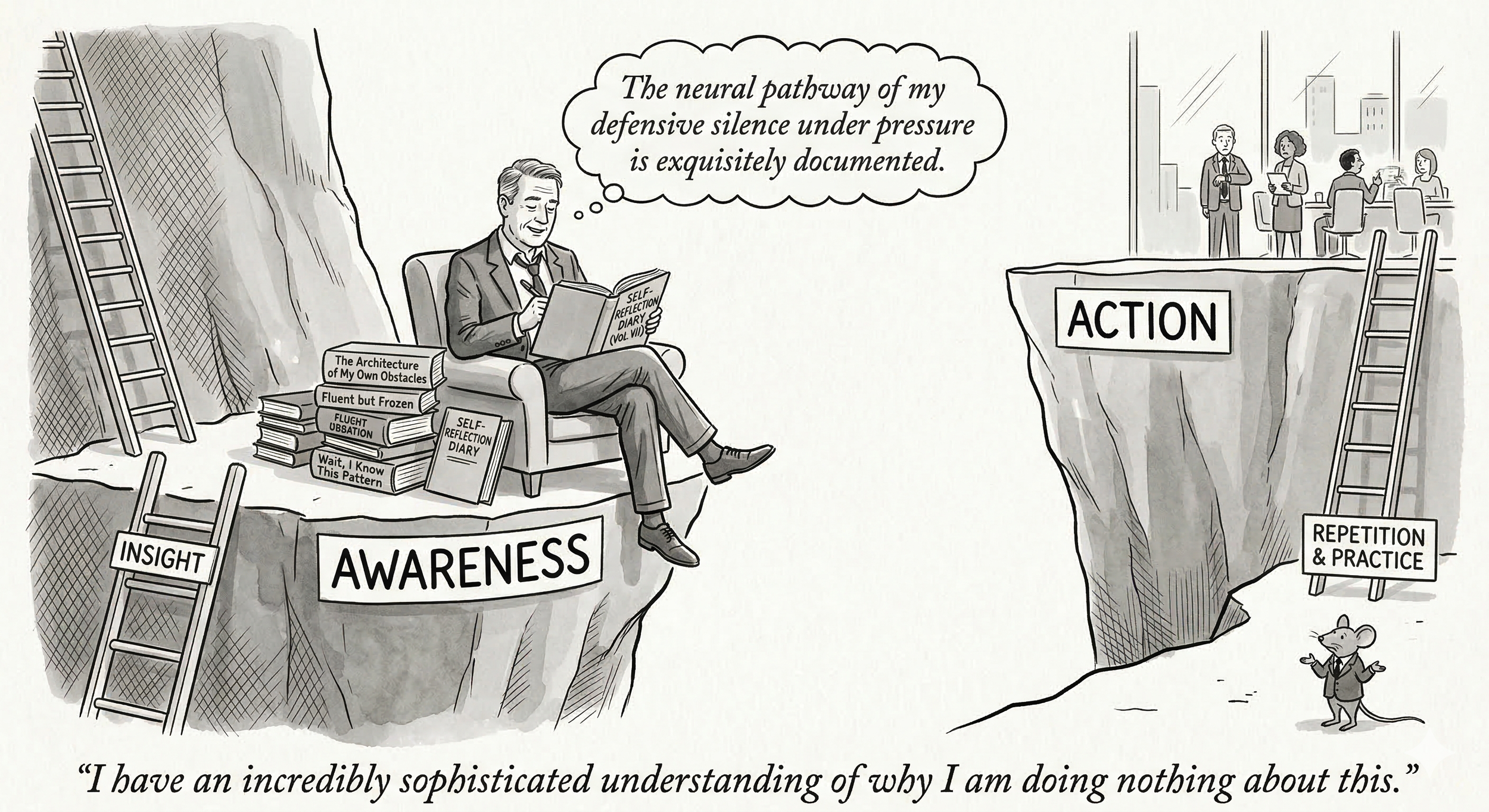
Self-awareness is the most celebrated skill in leadership development.
It might also be the most overrated.
Not because it doesn't matter.
Because leaders have mistaken it for the work itself.
Key Takeaways:
Self-awareness is necessary but insufficient
The body registers a trigger before the mind does
You cannot think your way out of a stress response
Repetition, not breakthrough, is how change happens
Most leaders I work with are remarkably self-aware.
And stuck.
They can describe their patterns with precision — the way they shut down under pressure, the compromises they keep making, the stories they tell themselves to get through hard decisions, the habits they know they should change.
They have done the reflection. They have the language.
But the behavior hasn't moved.
The gap that limits most leadership development isn’t between ignorance and awareness.
It’s between awareness and action.
And most leaders are living in that gap right now without a clear way across.
Insight Does Not Interrupt Behavior
Leadership does not change because you notice something. It changes when noticing interrupts behavior — when you pause long enough to override the brain's preference for the familiar and choose a different response.
That pause is where leadership capacity lives.
Without it, the old behavior simply runs on autopilot.
This is why reflection alone rarely produces change.
Planning feels productive. Anticipating improvement feels satisfying. In fact, the dopamine high of imagining a better future can feel more rewarding than the slower, messier process of actually building it.
When that happens, awareness becomes a substitute for action.
There’s a name for this dynamic: insight as self-soothing.
It doesn’t feel like avoidance. It feels responsible, thoughtful, even courageous.
It looks like a leader who journals extensively about a pattern they never interrupt in the room where it matters.
Or a leader who brings the same issue to coaching conversation after coaching conversation — articulating it with increasing sophistication, while the underlying behavior remains unchanged.
The insight becomes the destination, rather than the beginning of the journey. And the more fluent the leader becomes in describing the pattern, the easier it is to mistake that fluency for progress.
I know this firsthand and from my work with hundreds of other leaders.
Unless awareness alters behavior, reflection is a sophisticated way of staying stuck.
Why Insight Stalls
Consider what this looks like in practice.
A senior leader I worked with had a habit of filling every silence in meetings — interpreting any pause as a signal to elaborate or move on.
She knew this about herself. She could even feel it — a restless, almost physical discomfort the moment a meeting went quiet, an urge to fill the space that arrived before any conscious thought did.
She had reflected on it, discussed it, and understood exactly from where the habit came.
What she had not learned was how to interrupt it.
Her intervention was simple: ask one open-ended question and allow time for a response before speaking again.
The pause felt awkward at first.
Within three weeks, her team's participation had visibly shifted. The silence, it turned out, was where their best thinking lived.
The obstacle was never understanding. The obstacle was always the moment just after — when the pattern appeared, the old response felt automatic, and the pause required to choose differently felt unnecessary or inconvenient.
A Practical Framework for Interrupting Patterns
Interrupting self-limiting leadership patterns is not a personality trait. It is a learnable leadership skill.
Three shifts make interruption far more likely.
1. Notice the trigger — in your body first, then your mind
Every behavioral pattern has a trigger — a specific moment when it begins to activate. But most leaders try to catch it too late, at the level of thought, after the automatic response has already begun.
Here is what makes early detection possible: the body registers threat before the mind does. Your nervous system responds to a trigger in milliseconds — long before you have a conscious thought about what's happening.
That response has a physical signature. It might be a tightening in the chest, a clenched jaw, a subtle quickening of the breath, a heat in the face, or a restless urge to move or speak. These sensations are not noise. They’re information — and they arrive earlier than any thought you will have about the situation.
This means your body is the most reliable early warning system you have. Learning to read it is the difference between catching the pattern as or before it fires and recognizing it only in the rearview mirror.
The goal, then, is twofold: name the trigger precisely, and identify its physical signature.
Vague: "I get defensive when I'm challenged."
Specific: "When someone junior to me challenges my thinking in front of the team, I feel heat in my face and an urge to respond immediately — and that's when I default to defensiveness."
The physical sensation is the earliest signal available to you. The more reliably you can recognize it, the more time you have to choose what comes next.
2. Create a pause — through the body, not just the mind
Once you feel the trigger's physical signature, the pause is not merely a mental decision to slow down. It is a physiological intervention.
When your nervous system registers threat — a challenge to your authority, an uncomfortable silence, a conversation going sideways — it activates a stress response. Heart rate rises. Breathing shortens. The prefrontal cortex, where deliberate judgment lives, begins to cede ground to faster, more reactive circuitry.
This happens automatically. You can’t think your way out of it in the moment, because the thinking brain is precisely what the stress response is temporarily overriding.
What you can do is use the body to manage the mind.
A slow, deliberate breath — specifically a longer exhale than inhale — directly activates the parasympathetic nervous system and begins to down-regulate the stress response.
A planted foot, pressing deliberately into the floor, redirects attention from the mental loop back into physical sensation and grounds you in the present moment.
A single internal word — pause, wait, here — functions as an anchor, something the mind can hold while the nervous system settles.
Five seconds is enough. Not to resolve anything, not to formulate the perfect response — just to create the gap between stimulus and reaction where a chosen response becomes possible.
Without that gap, leadership becomes reflex. With it, it becomes a decision.
3. Replace — don't just resist
Willpower rarely works alone. Instead of trying to suppress the old behavior, decide in advance what you will do instead-- a replacement behavior.
Not: "I will stop interrupting."
But: "I will ask one question before responding."
Or:
Not: "I will stop avoiding conflict."
But: "I will name one thing I've been avoiding in my next one-on-one."
Substitution is neurologically far more effective than suppression. Once the nervous system has settled, the prefrontal cortex can execute the behavior you chose in advance — which is precisely why deciding on the replacement before pressure arrives matters. The brain needs somewhere to direct the energy that the old pattern was using.
Give it a better task.
Repetition Is the Real Work
Behavioral change does not require a breakthrough.
It requires repetition.
The leaders who grow are not the ones with the deepest self-knowledge. They are the ones who act on that knowledge — imperfectly and repeatedly.
Each interrupted pattern builds the neural pathway that reflection alone never will.
Insight tells you what to change.
The repetitions are how change actually happens.
This is the most underestimated truth in leadership development: there are no shortcuts between knowing and becoming. The only path from one to the other runs through repeated, imperfect practice — in real meetings, under real pressure, with real people watching.
Before Your Next Meeting
What is the exact trigger that activates your most persistent leadership pattern — and what does it feel like in your body in the moment before the old reaction fires?
That physical signal is your earliest opportunity to choose differently.
Answered specifically, that question becomes the beginning of work that awareness alone cannot do.
P.S. This is the kind of work I do directly with leaders in my coaching program — using the body to inform and manage the mind, identifying patterns that awareness hasn't changed, and designing the interruptions that shift behavior in real situations. Leaders I work with often describe the experience as finally feeling like their behavior matches what they already know.
If that resonates and you'd like to explore what that work might look like for you, feel free to reply to this email.
P.P.S. If you found this useful, consider forwarding it to a colleague who might benefit from it.